

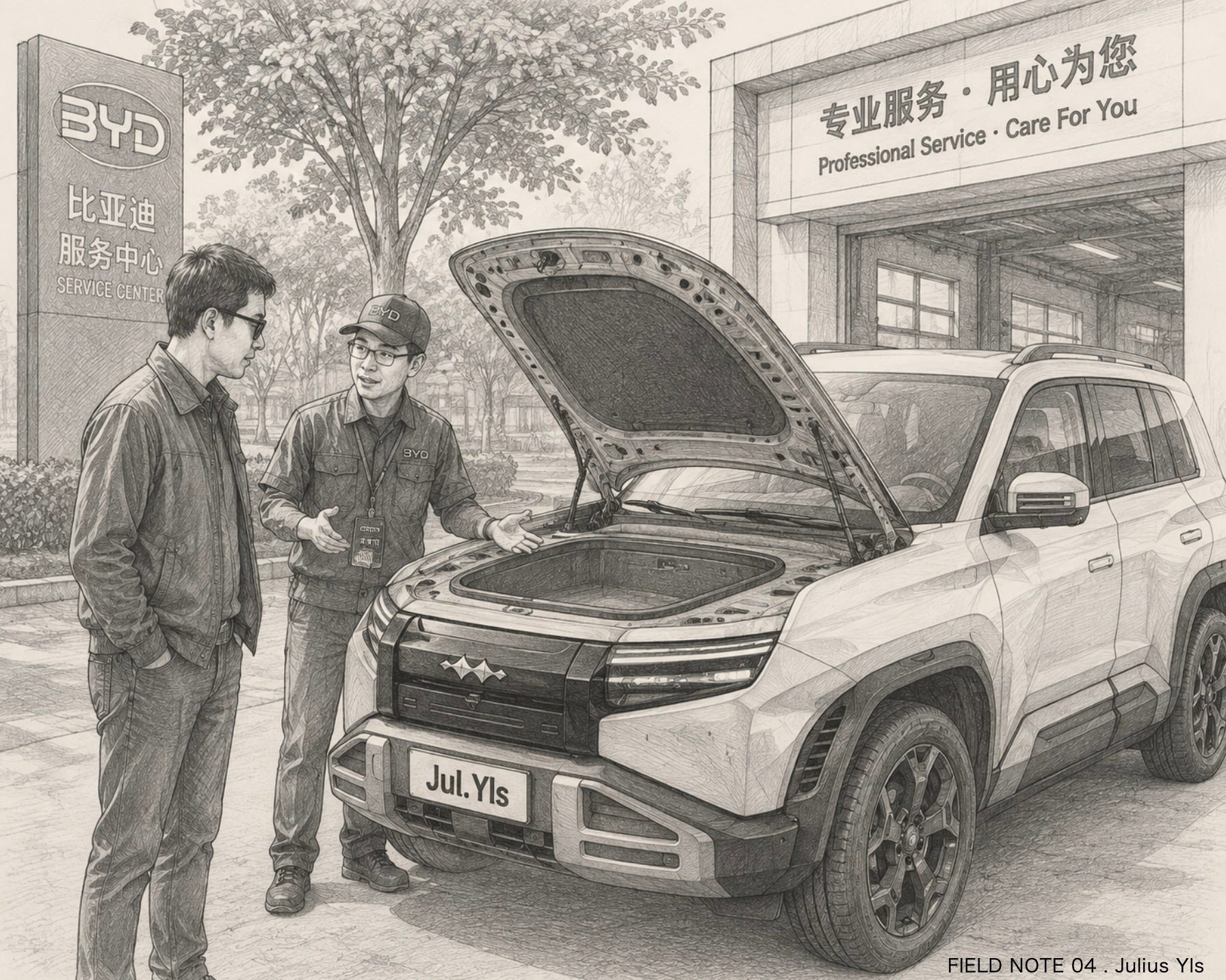
Last week, I took my EV back to the service centre for its first scheduled maintenance since buying it. It was a normal appointment, the kind of routine visit every car owner eventually makes.
But as I drove there, I realised that I was carrying more than thirty-five years of expectations with me.
For most of my driving life, taking a car for servicing had followed a familiar pattern. I have owned and driven different cars in several countries, but regardless of the brand or where the vehicle was made, there was always one thing at the centre of the visit.
The engine.
A Familiar Routine
The bonnet would open and the conversation would begin. Engine oil. Filters. Spark plugs. Belts. Fluids. Strange noises. Sometimes something inexpensive needed replacing. Sometimes the mechanic would find something that made the visit considerably less pleasant. Over the years, these things became part of what I understood car ownership to be.
Even drivers with little mechanical knowledge gradually learned the vocabulary. We knew when the oil needed changing. We listened for unusual sounds. We learned that certain smells, vibrations, or warning lights probably meant a visit to the workshop was coming.
Without really thinking about it, servicing a car had become closely tied to maintaining the mechanical system that made it move.
I had always thought of this as maintaining the car. That assumption was about to become less certain.
Looking Under the Bonnet
When I arrived at the service centre, much of the experience initially felt familiar. Technicians inspected the vehicle, checked the tyres, brakes, suspension, battery system, and connected diagnostic equipment.
Everything was being examined as it should be. But I kept waiting for the part of the conversation that had accompanied almost every car I had owned before, and it never came.
There was no engine oil to change because there was no engine. No spark plugs. No exhaust system. No fuel system. No timing belt waiting somewhere in the future to be replaced. Nothing was wrong. Nothing had been forgotten.
Those things simply did not belong to this vehicle.
Standing there, I had a strange realisation.
For thirty-five years, I thought I was maintaining cars. But perhaps I was actually maintaining engines.
What Had Disappeared
The internal combustion engine created an entire world around itself. Workshops, technicians, replacement parts, fluids, diagnostic skills, maintenance schedules, and generations of knowledge developed around keeping an extraordinarily complex mechanical system operating reliably. As drivers, we became part of that world too.
We learned its rhythms without necessarily noticing that we were learning them. Oil changes and servicing intervals did not feel like technological requirements. They simply felt like car ownership. That is what made their absence so noticeable.
The EV still requires maintenance. Tyres wear. Brakes and suspension need attention. Components need inspecting. Batteries and electronic systems need monitoring. But an entire category of mechanical activity that had accompanied me for most of my driving life was no longer there.
The difference was not simply that the new car had added batteries, software, sensors, and connectivity. It had also removed something, and I realised that I had been paying much more attention to what the EV added than to what it made unnecessary.
The Knowledge We Carry With Us
For years, I had learned to listen to cars. An unusual engine sound might suggest a problem. A change in vibration could mean something needed attention. The feel of the gearbox, the sound of the engine when starting in the morning, even the smell coming from somewhere under the bonnet could tell an experienced driver something about the condition of the vehicle. That knowledge accumulated slowly and it became part of my relationship with cars.
But much of it was knowledge produced by a particular technology.
When the technology changes, some of that accumulated knowledge remains useful. Some of it becomes less important. And some of it may eventually disappear with the system that created the need for it. That thought interested me more than the service appointment itself.
For decades, I had assumed that understanding a car meant becoming familiar with its mechanical condition. Now I was beginning to pay attention to different things: battery state, software behaviour, connectivity, sensors, charging, and the way different systems communicate with one another.
The relationship had not disappeared. It had moved.
When Progress Looks Like Absence
We often recognise technological change through what is added such as a larger screen, A new feature, Faster performance, More automation, A new form of intelligence, etc.
Those additions are easy to demonstrate because there is something new to point at. But my service appointment made me wonder whether some of the more significant changes are harder to notice because they appear as absences: No oil change, No petrol station, No exhaust pipe, No engine sound, No mechanical component waiting for its next scheduled replacement.
Nothing dramatic announces the disappearance. One day you simply realise that a familiar ritual has stopped being part of your life. That is what stayed with me after I left the service centre.
The absence of the engine had removed more than a piece of machinery. It had begun removing behaviours, vocabulary, maintenance routines, and small pieces of knowledge that I had accumulated over decades.
Perhaps this is another way technological change becomes ordinary. Something new arrives, but eventually the more revealing question is not only what it allows us to do.
It is what we slowly stop having to do. For me, it took an ordinary service appointment to notice that an entire part of car ownership had already begun to disappear.
Disclosure: I am not sponsored by BYD or any company mentioned in my Field Notes. The electric vehicle experiences shared here are based on my personal ownership and everyday use. Brand names and logos appear only because they are part of the real-world objects and environments I document. My current EV happens to be a BYD, but the focus of these observations is not the brand itself. It is the wider experience of how technology, mobility, and everyday life are changing. My writing reflects my own experiences, interpretations, and opinions.
This is a great piece of writing. I had a similar experience at my first EV service since ownership. Only, besides the tire rotation, I needed to address several recalls. Two minor parts would be replaced and the rest were software updates that required the car to be at the dealer. Thats when it dawned on me that this car needed a software engineer not a mechanic like my old car. Lifestyle change.