

Over ten days, my wife and I travelled through several cities in southern China in our EV. It was our first proper long road trip with the car, involving highways, hotels, shopping malls, city streets, mountain roads and plenty of unfamiliar places.
Before leaving, charging was naturally somewhere in the back of my mind. Our EV has a rated CLTC range of 501 kilometres, so a journey of this length would obviously require us to charge many times along the way.
What surprised me was how quickly finding a charger stopped being the interesting part.
Highway service areas appeared regularly along the route, and most of the ones we stopped at had charging facilities. In the cities, chargers appeared in hotel car parks, shopping malls, office areas and public parking facilities. Sometimes there were only a few. In larger car parks there could be rows of them. I had already started noticing this in earlier journeys. Charging was becoming something that fitted around whatever we were doing.
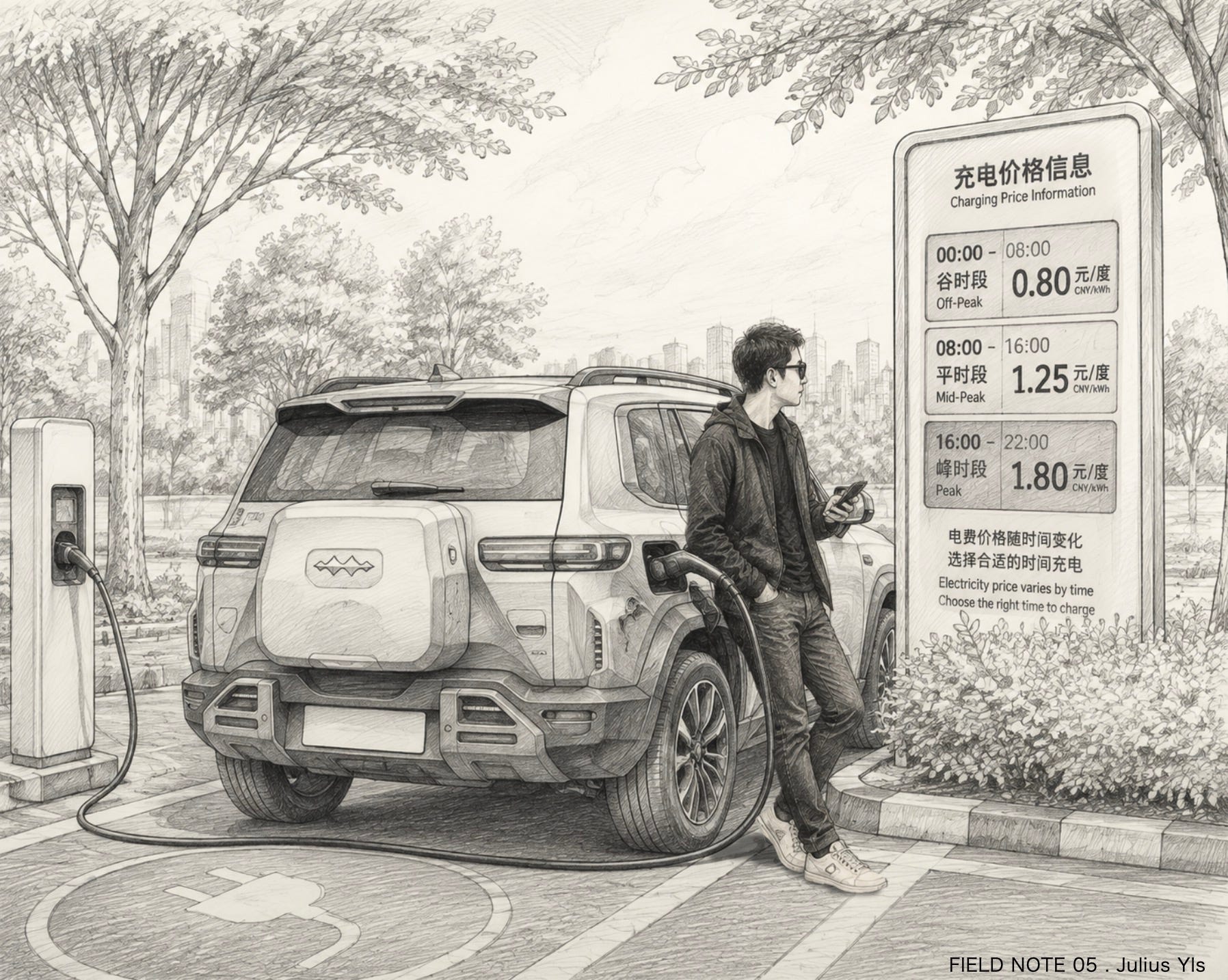
But during this trip, I began noticing something else. The price of the electricity could be remarkably different.
The Same Electricity, Very Different Prices
At one charging station, electricity might cost around RMB 0.6 per kWh. Somewhere else it could be RMB 1.2. At another location, particularly somewhere convenient or at a different time, I saw prices approaching RMB 2.5 per kWh. More than four times the price for electricity entering the same battery. Initially I treated this as another small detail of EV ownership. Then I realised how different it felt from the relationship I had developed with petrol during more than three decades of driving.
With a petrol car, when the tank becomes low, I find a petrol station and fill it. Prices vary, of course, but fuel is largely something I buy when the vehicle needs it. I might choose one station instead of another, but I rarely reorganise my day around the possibility of buying petrol for a fraction of the price somewhere else.
Charging the EV felt different.
The cheaper option did not necessarily require hunting for electricity. Often the choice appeared naturally because the car was already going to be somewhere. If we were stopping at a shopping mall for dinner and the chargers downstairs were inexpensive, we could charge there. If the hotel had slower charging available overnight, there was little reason to look for an expensive fast charger. On the highway, when we needed energy quickly, convenience mattered more and we used what was available.
The decision became a combination of price, time and what we were already doing.
Do I need the energy now?
Will the car be parked here for two hours anyway?
Is it staying overnight?
Is faster charging worth paying more for?
I realised that I was no longer simply asking how much energy cost.
I was beginning to decide what kind of convenience I wanted to buy.
Cheap Is Not Always Better
This did not mean that I always looked for the RMB 0.6 charger. If I am travelling on a highway and an RMB 2 charger gets us moving again quickly, paying more can make perfect sense. Saving RMB 15 or RMB 20 is not particularly useful if it requires leaving the highway, searching for another charger and adding half an hour to the journey.
The opposite is true when the car is going to sit somewhere for hours. A slower, cheaper charger can be extremely convenient overnight because I do not care whether the battery reaches the level I need at midnight, 3 am or 6 am. I only care that the energy is there when I leave.
Sometimes I was paying for speed. Sometimes for convenience. Sometimes I was simply taking advantage of inexpensive electricity because the car would have been parked anyway. That was a small but significant change in the way I thought about vehicle energy. For most of my driving life, fuel had been a requirement.
Now energy was beginning to feel like a set of choices.
Where Does the Energy Come From?
This reminded me of something I had seen before our trip. I came across a YouTube video about a couple living on a rural property in Tasmania, Australia. They had been working towards making their property more self-sufficient, with solar panels and a home battery. Later, they replaced their petrol vehicles with an EV. What stayed with me was how they charged it. When sufficient solar electricity was available, they could use energy generated on their own property to charge the car.
At first, I simply thought of this as cheap charging. After our road trip, I began seeing it differently. They were not only choosing where to buy energy. They were producing some of it themselves.
That possibility does not really exist in the same way with a petrol car. I cannot realistically produce petrol on the roof of my home. Electricity is different. It can come from a public charging station, a hotel, a shopping centre, the electricity grid, or solar panels on someone’s roof. It can be stored in a household battery or in the much larger battery sitting underneath an electric vehicle.
That changes the question, instead of only asking, “How much does my fuel cost?”, I can begin asking, “Where should the energy come from?”
And then another question appears: “When should I use it?”
I Had Already Experienced the Other Direction
Thinking about the couple in Tasmania reminded me that my wife and I had already experienced another side of this ourselves. A few months earlier, we had taken the EV for some light camping in the mountains. When it was time for tea and hot pot, we plugged our cooking equipment into the car. Our EV can provide up to 6,000 watts of external power, so the battery became a surprisingly capable portable electricity source. At the time, I did not think deeply about it. I was mostly pleased that we could boil water and cook without bringing a separate generator.
But something interesting had happened. For most of my driving life, energy travelled in one direction: I put energy into the car so the car could move. That afternoon, some of it came back out. The same battery that had carried us into the mountains was now boiling our water and cooking our food.
Technically, this function is known as vehicle-to-load, or V2L. But what interested me was less the terminology than the change in relationship.
The car was no longer simply consuming energy. It could carry energy somewhere and make it useful after we arrived.
The Value of Waiting
Electricity also introduced another possibility that petrol had rarely made me think about: Time.
If my car is parked at a hotel from 9 pm until 8 am, I do not necessarily care when most of the charging happens during those eleven hours. I care that there is enough energy when I need to leave. That ability to wait creates flexibility.
Electricity supply and demand change during the day. Renewable generation also changes depending on conditions. Smart charging systems can increasingly respond to some of those variations rather than treating every plugged-in vehicle as something that needs to charge immediately at maximum speed.
I began seeing the price differences I encountered during our road trip differently. RMB 0.6 and RMB 2.5 were not simply cheap and expensive versions of the same thing. They were also reminding me that electricity exists inside a much more dynamic system.
Where I charge matters.
When I charge can matter.
How quickly I need the energy matters.
Where the electricity comes from can matter.
Suddenly there were several variables where petrol had mostly given me one.
From Consumer to Participant
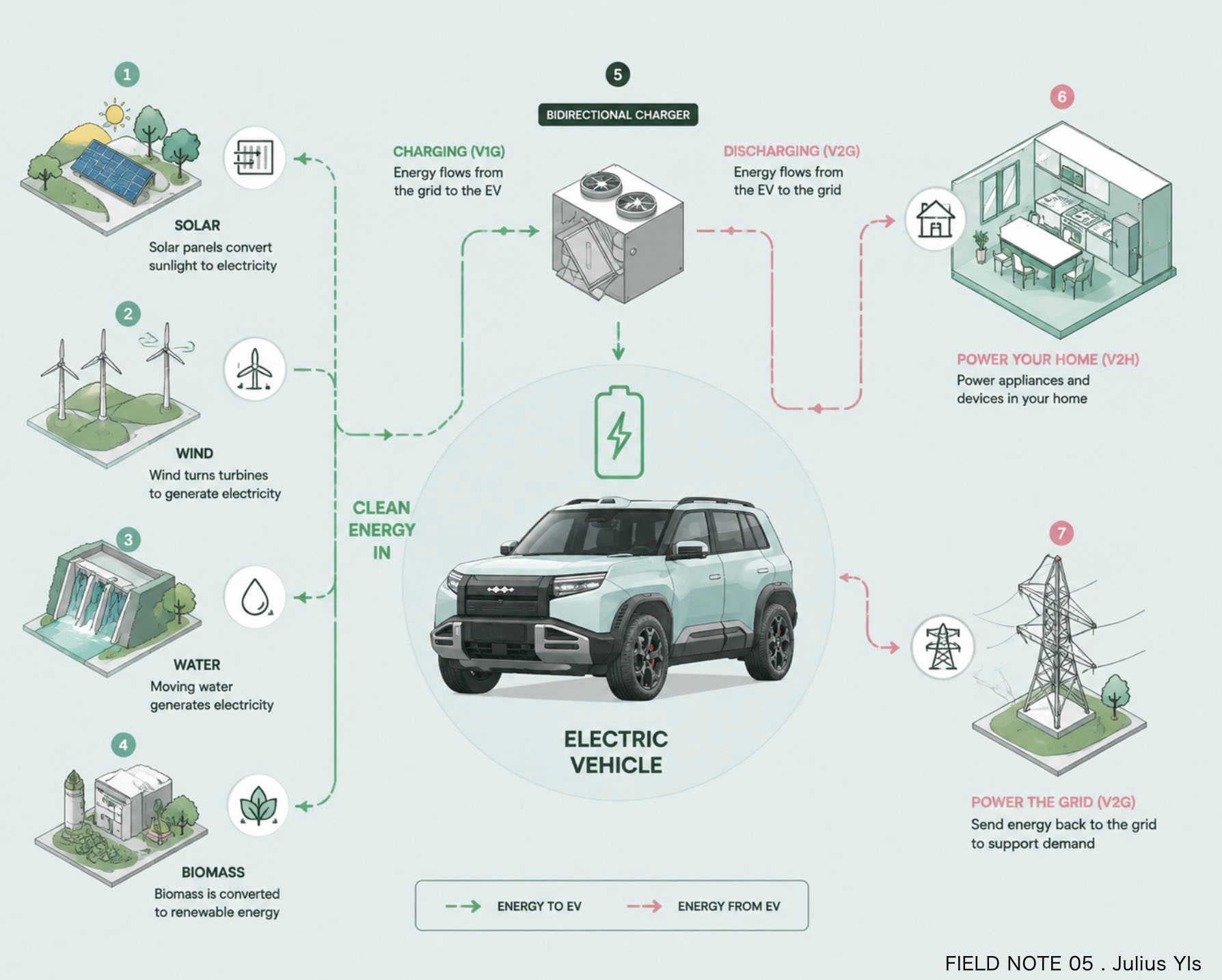
The relationship may become more complicated still. Vehicle-to-grid systems are being explored as a way for electric vehicles not only to receive electricity but, under appropriate conditions, to make some stored energy available elsewhere.
That does not mean every EV will become a miniature power station, and I do not know how widely these systems will eventually be used. But simply understanding that the possibility exists changes how I see the battery underneath my car. It is not necessarily only a fuel tank with electrons instead of petrol. It is storage, it can receive electricity from different sources. It can wait for a useful time to charge.
In some situations, as I experienced while camping, it can make that stored electricity useful somewhere else. The boundaries become less fixed.
When Energy Became a Choice
I began our road trip noticing the price of charging. By the end, I was thinking about something much larger: For most of my driving life, my relationship with energy was simple. The vehicle consumed fuel. When it ran low, I bought more.
Electrification does not automatically change that relationship. I can still use an EV in almost exactly the same way. Drive until the battery becomes low, find a charger, pay whatever it costs and continue.
But electricity gives me possibilities that petrol never really offered. I can choose speed or price. I can charge while doing something else. I can wait. I can use energy generated somewhere differently.
Someone with solar panels may produce part of their own transport energy. The battery can even make electricity available again after the vehicle has reached its destination.
The important change, I realised, was not simply that petrol had been replaced by electricity. It was that energy itself had become more flexible.
And once energy becomes flexible, the driver is no longer only a consumer standing at the end of a fuel supply chain. We begin to have choices about where energy comes from, when we use it, what we are willing to pay for convenience and, occasionally, what happens to that energy after it enters the car.
I started the journey comparing charging prices. I ended it thinking about something I had almost never considered during thirty-five years of driving:
What kind of relationship do I want to have with energy?
Julius, this article helped me to better understand the power of our electric vehicles. We once owned a large home in Utah where we installed solar panels on the roof. There was a certain smugness in powering our home with solar energy, not to mention the huge savings on our power bills. Solar worked beautifully in arid climates where there are clear skies and few trees. I think all new construction, in many parts of the US, should be forced to include solar energy. But there are, of course, the naysayers. We had neighbors who complained about the 'ugliness' of the panels, and when we sold that house, the buyers removed the solar panels. Our average monthly bills for most months of the year was $10, the standard usage fee charged by Rocky Mountain Power. This for a 4,000 square foot home. The summer bills, when we ran the air conditioning systems non-stop, were a bit higher, but never hit the $100 mark. Brilliant to use the EV to brew tea, and provide power for camping. Using solar power to refuel the EV? Mindblowing.
As mentioned in this Field Note, here is the YouTube video from the couple in rural Tasmania. Their experience of using solar energy from their own property to charge their EV is a great real-world example of how our relationship with energy is changing: https://www.youtube.com/watch?v=3xS7wkRr_Bc&t=610s