

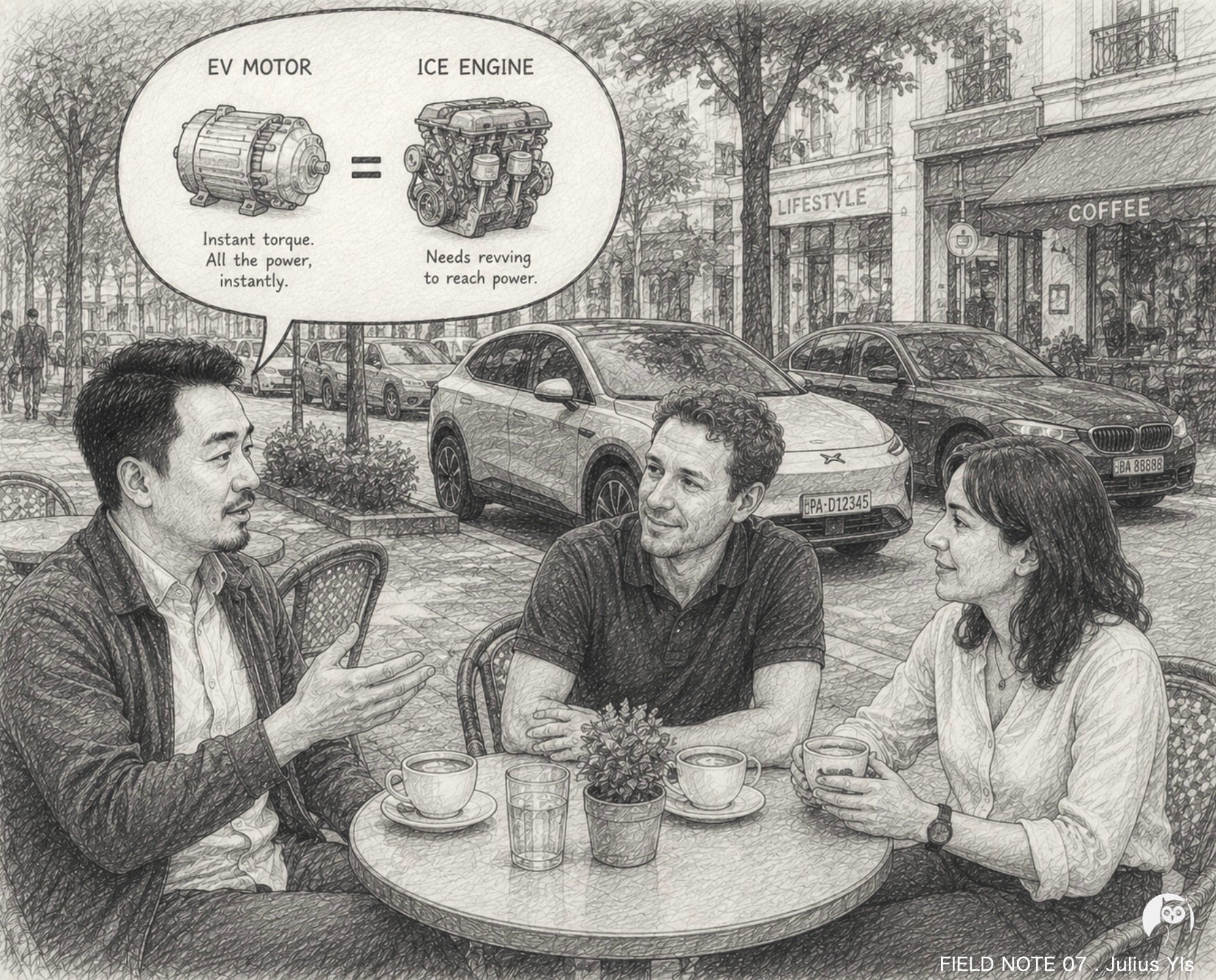
Recently I took a friend and his wife out for coffee in my electric car. They had only recently moved to China, so much of what they were seeing around them including the number of electric cars on the road which was still relatively new to them. On the way to the café, my friend began asking about the car. We talked about the usual things for a while: range, charging, how it felt to drive.
Then he asked me a question that stopped me for a moment: “If your EV were a petrol car, what size engine would it have? Two litre? Three litre?”
I knew exactly what he meant. He had just experienced the acceleration and responsiveness of the car, and he was trying to translate that experience into a language he already understood. For most of my driving life, I would have done exactly the same thing. So I started trying to answer him, Two litres? Perhaps three? For a few seconds I found myself mentally searching through the petrol cars I had driven over the years, trying to find an equivalent. Then I realised that the comparison didn’t really work. There was no engine displacement to convert. An electric motor has no cylinders to measure in litres. Even the way the performance arrives is different.
What interested me wasn’t that my friend’s question was wrong. It was that both of us instinctively tried to understand a new machine through the vocabulary of the old one.
Old questions, new machines
In an earlier Field Note, Meeting New Technology on Old Terms, I wrote about the Einstellung effect: our tendency to approach a new problem using a familiar pattern of thinking that has worked before. Previous experience can become so dominant that it makes alternative ways of seeing the problem harder to recognise.
I realised how deeply the combustion engine had shaped not only the car, but the language we use to understand one. Litres. Cylinders. RPM. Gears. Exhaust note. These weren’t simply technical specifications. Over many decades they became part of the cultural vocabulary of motoring. A person who knew very little about engineering could still understand that a three-litre engine probably meant something different from a one-litre engine.
Then, in the EV, the combustion engine disappeared, but much of the vocabulary remained. That made me wonder whether something larger is happening. Perhaps electrification isn’t simply replacing one way of propelling a car with another. Perhaps the car itself has arrived at a moment when our idea of what a machine should be is changing.
I think we have seen this before
In January 2007, Apple introduced the first iPhone. It is easy, almost twenty years later, to remember it simply as the moment buttons disappeared and the touchscreen took over. But the more important change was not the screen.
Apple presented the iPhone as three things combined: a telephone, an iPod and an Internet communications device. The following year, in 2008, the App Store arrived, and the object began developing into something much larger: a platform on which other people could build software and services.
The smartphone itself wasn’t invented by Apple. Mobile email, Internet-connected phones and touchscreens already existed. What changed was our expectation of what the object could become.
At some point, asking whether an iPhone was a good telephone stopped being a particularly useful way of judging it. Of course it still made telephone calls, but increasingly we bought smartphones to take photographs, navigate cities, read newspapers, listen to music, pay for things, order food, watch films, work, argue with strangers, talk to our families and, more recently, carry an AI assistant around in our pocket.
The telephone function didn’t disappear. It became one function among many. I wonder if something similar is beginning to happen to the car.
The world around the car has changed
The last fifteen years have been an unusually restless period in technology. Smartphones moved computing into our pockets. Cloud services connected our devices to systems elsewhere. Digital payments changed how money moved. Social platforms changed how information circulated. Blockchain proposed new ways of organising trust. The metaverse briefly suggested that much of our lives might migrate into persistent virtual worlds.
Some of these ideas became infrastructure. Some found narrower uses than initially imagined. Some arrived with rather more enthusiasm than longevity. And now AI is moving rapidly into everyday objects and services.
I don’t think this sequence caused the electric car. Electric cars, after all, are older than any of these technologies. But perhaps these waves have gradually changed what we expect technology around us to do.
We increasingly expect important devices to know where they are, connect to other services, understand instructions, remember preferences, update themselves, automate things and, increasingly, have some degree of intelligence.
Seen from that perspective, the contemporary EV arrives at an unusually appropriate moment. Not because electricity is somehow inherently digital, but because electrification has given manufacturers an opportunity to reconsider the automobile at roughly the same time that the rest of society is becoming more software-defined.
China makes this particularly visible
Living in China, it is difficult to separate these two transitions. The move towards electric cars is happening inside a society where digital services are already deeply embedded in everyday life. Navigation, QR payments, food delivery, ride-hailing, shopping, messaging and countless other services already move easily between smartphones and the physical world.
So perhaps it isn’t surprising that many cars here are developing in a similar direction. Voice assistants, phone apps, cameras, connected navigation, assisted driving, remote controls, OTA updates and increasingly AI are becoming part of the everyday conversation about cars.
Recent research into the Chinese market points in the same direction. McKinsey’s 2025 consumer study found technological innovation becoming increasingly important relative to price, while intense discounting was producing only marginal additional sales growth. Chinese consumers, meanwhile, were actively embracing new models and emerging technologies.
This may complicate one common explanation for China’s rapid EV adoption. From outside China, the story is often presented primarily as one of economics. China can manufacture batteries cheaply. Chinese manufacturers compete aggressively on price. Government support helped build the industry. Charging infrastructure expanded. Therefore consumers switched from petrol to electric cars.
All of those things matter enormously. But perhaps price is only part of the explanation.
In 2025, close to 55 percent of new cars sold in China were electric, a category that includes both battery-electric and plug-in hybrid cars. Nearly 70 percent of those electric-car sales were battery-electric.
At that scale, the electric car is no longer simply an alternative technology being offered to a reluctant public. It has become part of the ordinary automobile market. So perhaps another force is operating alongside affordability.
The car itself may simply be becoming better aligned with the technological environment around it. Perhaps China didn’t only make the new kind of car cheaper. The society around the car was also becoming ready for a different kind of machine.
When experience becomes a constraint
This brought me back to the Einstellung effect. It is easy to see it in individuals: my friend asked about engine size, and I tried to answer. But organisations can inherit mental models too.
A manufacturer that has spent a century becoming exceptionally good at designing combustion-engine cars possesses an extraordinary amount of knowledge. Engines, transmissions, supplier networks, platforms, servicing, dealerships, manufacturing processes and product-development cycles have all been refined over decades.
That expertise is an enormous advantage. But accumulated expertise can sometimes make a different question harder to ask.
If the starting question is:
How do we make our existing car electric?
the result may be very different from asking:
What should a car become now that the engine is no longer at its centre?
This doesn’t mean traditional manufacturers are incapable of producing excellent EVs. Many now have dedicated electric platforms and are redesigning their software architectures. But the difficulty may go deeper than replacing engines with motors.
Some manufacturers may have electrified the drivetrain faster than they have changed their idea of the car.
The automotive industry is now moving towards what is increasingly called the software-defined vehicle: cars whose functions can evolve through software, OTA updates and increasingly centralised computing architectures. The IEA notes that pure-play EV makers have led much of this shift, although established manufacturers are now moving in the same direction.
Perhaps this helps explain why some newer Chinese cars can feel less like traditional cars that happen to be electric and more like digital products that happen to have four wheels.
Whether that is always desirable is another question. I occasionally miss the simplicity of a button.
Maybe the engine isn’t the point anymore
My friend’s two-litre question stayed with me, not because he misunderstood my car. In fact, I think his question revealed something much more interesting. Technological transitions often leave the old object visible inside the new one.
Early cars were described as horseless carriages because the carriage was the object people already understood. Early smartphones were judged as telephones because the telephone was the object we already understood. And perhaps we are still judging EVs primarily as cars whose engines have been replaced.
Range becomes the size of the fuel tank. Charging becomes filling the tank. Battery longevity becomes engine longevity. Motor output gets translated back into engine size.
These comparisons are useful. Sometimes we need them simply to make unfamiliar technology understandable. But eventually there comes a point when the analogy begins to restrict what we can see.
Nearly twenty years after the iPhone, almost nobody asks what kind of telephone is hidden inside their smartphone. We ask instead what the whole device allows us to do. Perhaps the automobile is approaching a similar moment.
The petrol car isn’t suddenly useless. Nor does every EV represent some inevitable technological future. But the environment surrounding the automobile has changed. Software, networks, energy systems, sensors and now artificial intelligence are converging around an object whose dominant mental model has remained remarkably persistent for more than a century.
Maybe China’s inexpensive EVs are succeeding not only because they make electrification affordable. Maybe they arrived when the expectations of society were already moving in their direction.
And perhaps that is why my friend’s perfectly sensible question suddenly became so difficult to answer.
The hardest part of removing the engine, I realised, may not be taking it out of the car. It may be taking it out of our idea of what a car is.