

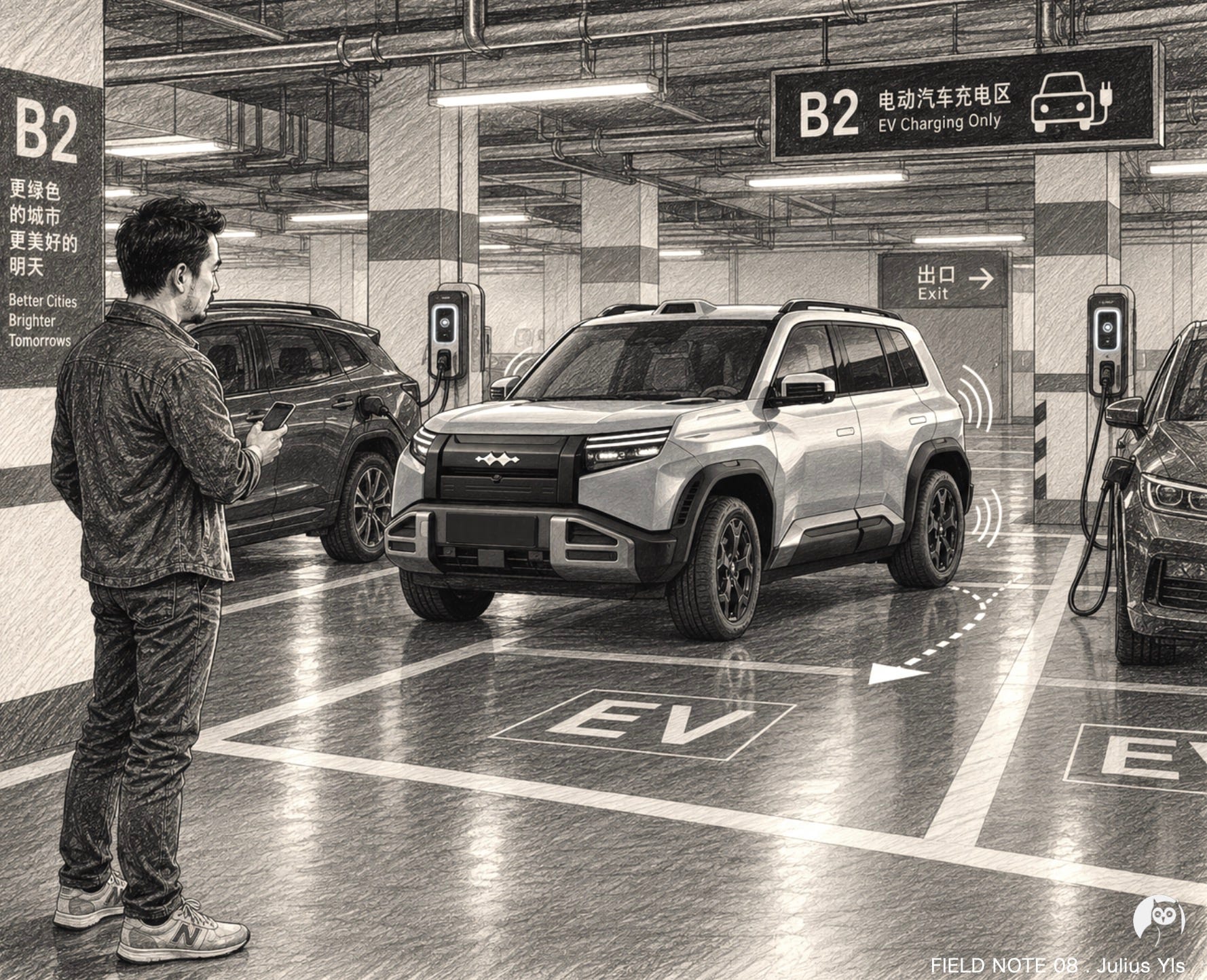
Recently, I have been getting out of my car before it start parking by itself.
I select a parking space on the screen, step outside, and confirm the auto valet parking function through my phone. The car then moves into the position I have chosen and completes the manoeuvre by itself. It is a small thing to describe. It feels rather different when it is your car moving and you are standing beside it.
For most of my driving life, parking has been the final task before leaving the vehicle. Now I can leave the driver’s seat first. I decide where the car should go, and it deals with getting there.
There is another function I use when someone has parked so close that I cannot get through the driver’s door. Through the phone app, I hold a directional control and move the car slowly out of the space until I can get in. It creeps along at roughly one kilometre per hour. Not particularly cinematic, but considerably more dignified than climbing across from the passenger side.
These are two different arrangements. In auto valet parking, the car carries out the manoeuvre after my confirmation. With remote movement, I remain directly in control through the phone. What connects them is how quickly they have become useful. I am beginning to think less about the technology and more about whether I need it today.
And that has led me to a larger question. If handing over a few metres of movement makes practical sense in a car park, where else might it make sense?
Beyond the parking space
Living in China, I am watching the possibilities expand well beyond the little manoeuvres I use. Manufacturers are developing parking functions that follow learned routes through garages and between floors, for example, can learn a route after one drive. The task is growing from fitting a car into a space to managing more of the journey towards it.
However, “self-driving” is an unusually generous phrase. It can describe very different relationships between a person and a vehicle. China’s classification has six levels, L0 to L5. Broadly, L0–L2 cover assistance to a human driver, while L3–L5 assign progressively more of the driving task to the system. The crucial distinction for understanding today’s passenger cars is between L2 and L3. At L2, the driver must continuously supervise, even when the car controls both steering and speed. At L3, the system can undertake the driving task within specified conditions, although the person must remain available to take over when required.
That is a substantial change in what the person is expected to do. It also needs more than a convincing demonstration. In December 2025, China granted its first conditional product approvals to two L3 passenger-car models, restricted to specified roads and conditions in Beijing and Chongqing.
Responsibility does not disappear with the driving task, either. The level alone does not determine liability after a crash. Shenzhen’s rules, for example, distinguish between vehicles with drivers and fully automated vehicles operating without them, with responsibilities involving drivers, owners or managers, and possible recovery from manufacturers where defects caused the damage. There are still people and organisations behind the empty seat.
Meanwhile, autonomous taxis are making that empty seat part of a transport service. In October 2025, Pony.ai and Xihu Group announced city-wide permits for fully driverless commercial robotaxi operations in Shenzhen. Across the Pacific, Tesla’s Cybercab began offering rides in Austin in September 2026. Its lack of a steering wheel makes the intended role of the occupant quite clear. You are a passenger from the beginning. Both examples still need to be understood within their operating limits.
An earlier example interests me just as much. In 2022, Bosch and Mercedes-Benz received approval for Level 4 driverless valet parking at Stuttgart Airport’s P6 garage. Compatible cars work with infrastructure inside the building to park themselves. The building has a role in making the driving possible. That seems an important clue to how this future might develop.
Already at Work
Alongside passenger cars, other autonomous vehicles are getting on with less glamorous work: carrying deliveries, cleaning roads and moving things through buildings.
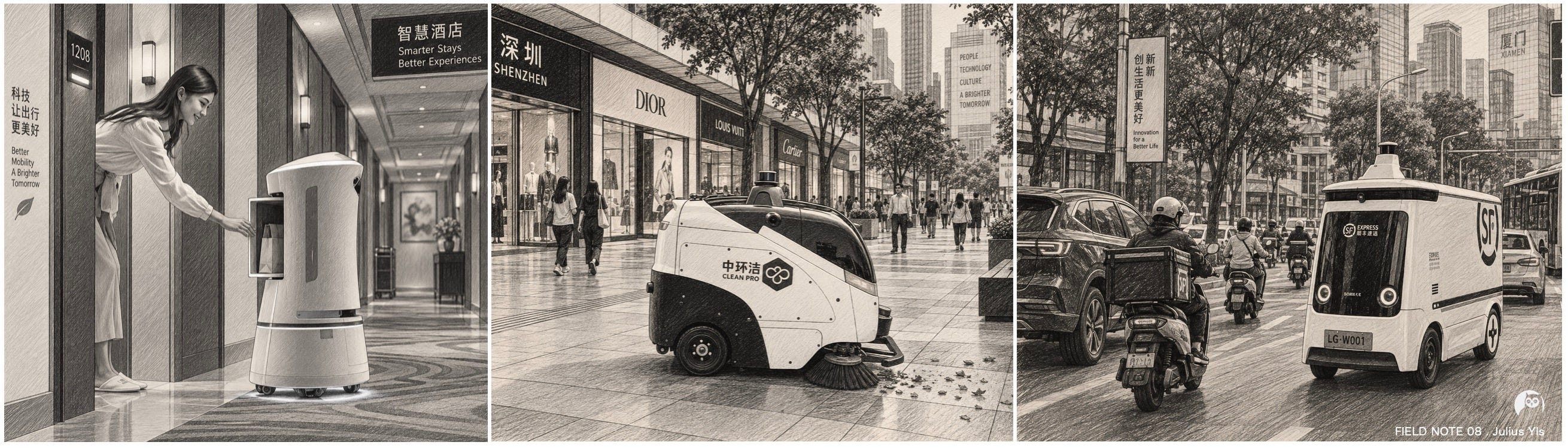
In May 2021, Beijing authorised JD[dot]Com, Meituan and Neolix to operate unmanned delivery vehicles on public roads within its demonstration area. The permissions came with speed limits, identification requirements and arrangements for human supervision. The technology and the rules around it were developing together.
In March 2026, a project in Shenyang introduced twelve Level 4 autonomous sweepers for main roads in Tiexi District. Their work was organised through an operations platform. It is difficult to imagine a street sweeper attracting the attention of a new sports car, but keeping a city clean is a fairly good reason for a vehicle to exist.
Hotel delivery robots offer a related example on a smaller scale. Machines such as Pudu’s FlashBot can use integrated elevators to make deliveries between floors. Like the parking system in Stuttgart, they work partly because the surrounding environment supports the task.
I think of these as quiet pioneers of everyday autonomy. Each has a defined job and a bounded environment in which to perform it. Their value can be judged through repeated use: did the delivery arrive, was the route cleaned, could the service continue when something unexpected happened?
They also remind us that autonomous movement involves more than a machine finding its way. Jinan’s rules for “functional unmanned vehicles” cover delivery, cleaning and patrol equipment, with requirements for insurance, remote assistance and human intervention. Someone still needs to deal with the blocked route or the vehicle that cannot continue.
This is how I can imagine autonomy becoming ordinary: through useful tasks, operating conditions and experience accumulated one journey at a time.
When the city asks more of the driver
I have driven in metropolitan traffic such as New York, Rome, Madrid, Dubai, Berlin, Bucharest, Singapore, and now China. Each place requires a period of adjustment. Knowing how to drive the car is only the beginning. You also have to learn how the city works.
Which lane should I already be in? Is that entrance open to everyone? Does the restriction apply at this time of day? Where can I stop without blocking someone else? And what is the motorcyclist beside me about to do?
My impression is that this interpretive part of driving is becoming more demanding. There are more layers to understand, often while moving through an unfamiliar place. Navigation helps, but a spoken instruction to turn left cannot settle every question about what is happening around that turn.
I sometimes feel that driving in a new city requires a short postgraduate course, ideally completed before the next junction.
This does not mean every city is getting worse, or that more technology is always the answer. Good public transport, clearer streets and fewer unnecessary car journeys can reduce the problem. But where large numbers of vehicles must share limited space, coordination remains difficult.
Every driver sees a small part of the situation. We judge a gap, anticipate a light, hesitate at an entrance or change lanes because we have realised something a little late. A perfectly understandable decision inside one car can become an unexpected event for the driver behind it.
That is where my interest in autonomous driving moves beyond personal convenience. In some environments, could a system organise movement more reliably than many people making separate decisions with incomplete information?
Imagine a busy airport access road, a large underground parking complex or a dedicated urban corridor. If automated vehicles could follow agreed rules for spacing, speed and entry, perhaps the whole place could work more smoothly. That would have to be demonstrated, and by putting automated vehicles together does not automatically make them coordinated.
But if it did work, I can imagine the next step being a requirement to use automated mode within that particular area. That possibility no longer feels especially distant to me.
A scene from an old future
It brings to mind “I, Robot”, the 2004 film with Will Smith. Automated driving is ordinary in that imagined world. When Detective Spooner chooses to drive manually, his passenger reacts with alarm, particularly at the speed they are travelling. Later, his manual driving also attracts attention from Traffic Operations. The film treats taking the wheel as a conspicuous decision.
What interests me now is the reversal of expectation. Many of us still feel that holding the steering wheel is the reassuring option. In that fictional future, the person insisting on driving becomes the unsettling variable.
Of course, a film involving a robot uprising is a slightly awkward advertisement for handing over control. Still, the scene gives shape to the question I keep returning to. Could there be places where manual driving eventually becomes the exception because the surrounding traffic system is organised around automation?
I am not imagining a date when everyone must surrender their steering wheel. I am thinking about specific situations where entry might come with a condition: this section operates automatically.
Such a requirement would need convincing evidence of safety, a workable response to failure and arrangements for people whose vehicles cannot participate. It should solve a real transport problem. The existence of the technology would not be enough.
But as metropolitan traffic asks more of individual drivers, the possibility deserves serious consideration. We already accept that shared roads place limits on individual choice. Automated operation could, in certain places, become another of those limits.
Designing the handover
My background in human–computer interaction and design makes me curious about where the work goes when we automate something.
There is a useful idea called distributed cognition: thinking and coordination can be spread across people, tools and their environment. It asks us to look at the whole arrangement through which a task gets done.
The examples here make that idea quite tangible. A hotel robot depends on the elevator connection. A parking car may depend on the building. A delivery vehicle depends on the people and systems supporting its route. For designers, the handover itself becomes important. Does the person understand what the machine has accepted responsibility for? Can they tell when it is uncertain? If it needs help, is the request clear and timely?
I recognise a related question in education. As tools take on more of a task, we have to reconsider what competence means. There is still knowledge to learn and judgement to develop. Knowing when to rely on a system, and recognising when its limits have been reached, becomes part of being capable.
For driving, that change may be uncomfortable. The steering wheel gives us a very direct sense of control. Letting go asks us to trust an arrangement that extends beyond what we can see from the seat.
Yet I suspect many of us will begin with something quite ordinary. A difficult parking space. A delivery that arrives. A journey through a busy place that becomes a little easier.
For me, it began by stepping out of the car and letting it finish parking. The first few metres were easy to hand over. What interests me now is how much of the city might eventually ask us to do the same.
I can picture a situation where you go through a toll booth that requires you to switch on autonomous driving to get through. Then the car takes you to your destination, drops you off, and goes off to park itself. Then you call it to return and pick you up, and take you back home. It would be interesting for congested cities to adopt this. As long as public transportation is still an option. You’d no longer have angry, frustrated, entitled drivers causing mayhem.