

Six months ago, if someone had told me that I would buy a Chinese EV, I would probably have smiled politely and changed the subject. I had spent more than thirty-five years driving across different parts of the world, and like many people of my generation, my understanding of a car was shaped by engines, gearboxes, fuel tanks, servicing, and the occasional unexpected repair bill.
My early academic background was in Mechanical Engineering, which probably reinforced that way of thinking. To me, a car was a machine. A wonderfully complicated machine, certainly, but still a machine.
The Skeptic and the Machine
When my wife and I moved to China, we eventually reached a familiar point: we needed a car. Naturally, I started looking at the brands I already knew from years of living in different countries, including Toyota, Honda, Mazda, Audi, and Volkswagen. The usual suspects.
I had little interest in Chinese electric vehicles. Not because I had anything against them, but simply because I did not know enough about them. Yet the longer I lived in China, the harder they became to ignore. They were everywhere.
To help me decide what to buy, I rented a petrol Toyota for two weeks. Driving it felt like meeting an old friend. Everything was familiar, predictable, and comfortable. The less pleasant part came whenever I visited the petrol station. Filling the tank cost around RMB 400, roughly US$60. After decades of driving petrol cars, I had learned to accept this as part of owning a car.
Then I rented a BYD DM-i hybrid. It could travel more than 1,000 kilometres using its battery and a tank of petrol, and the efficiency was difficult to ignore. I was also surprised by how refined the driving experience felt.
But something kept bothering me. The car still carried an engine, which meant motor oil, filters, spark plugs, and all the other mechanical rituals that had accompanied cars for generations. I eventually found myself asking a very simple question: if I am going to drive mostly on electricity anyway, why am I still carrying an engine around?
The Problem with Old Questions
That question eventually led me to buy a full EV. At first, my reasoning was embarrassingly practical. A full charge cost me around RMB 40, about US$6, while a petrol fill-up could cost around RMB 400. I did not need much engineering knowledge to understand the difference.
But my bigger hesitation was not really about the car. It was about charging.
When I had previously thought about owning an EV in places such as Singapore or Malaysia, the question in my head was always the same: where will I charge it? Living in China slowly turned that question around. I began wondering why I was still worrying about charging at all.
Chargers appeared at shopping centres, public car parks, residential areas, office complexes, tourist destinations, and highway service areas. I would go somewhere to eat, shop, meet someone, or simply stop during a journey, and charging was often already there. By the time I became an EV owner, charging no longer felt like an experimental activity requiring a special expedition. It was becoming part of ordinary life.
That was my first important realisation: I was not evaluating a vehicle. I was evaluating an ecosystem.
The car made sense partly because of everything that existed around it. What surprised me was that my assumptions had taken longer to change than the environment itself. I had been asking questions formed by years of living with one technological system while standing inside another one.
From Vehicle to Ecosystem
I assumed that buying an EV meant replacing an internal combustion engine with a battery and an electric motor. That turned out to be a very incomplete description of what I had bought.
The car has its own SIM card and data connection. It communicates with my phone, allows me to monitor charging remotely, check its status, unlock it, control various functions, and even move it without sitting behind the steering wheel. At some point I noticed something strange: I was interacting with my car surprisingly often when I was not actually inside it.
For most of my driving life, my relationship with a car began when I opened the door and ended when I walked away from it. Now that boundary was becoming less clear. The vehicle had begun to exist as part of my digital environment as much as my physical one.
Then there was the voice assistant. I have spent many years working with interactive media and emerging technologies, so voice interfaces were nothing new to me. I had used systems such as Apple CarPlay and Android Auto many times, but I usually experienced them as voice-operated menus.
This felt different. I found myself having contextual exchanges with the car to adjust settings, manage navigation, control functions, and deal with things while driving without reaching for a screen. What interested me was not whether the assistant was technically impressive, but how quickly I began treating the interaction as normal.
A behaviour that would once have seemed unusual gradually became part of driving.
When the Car Became a Power Source
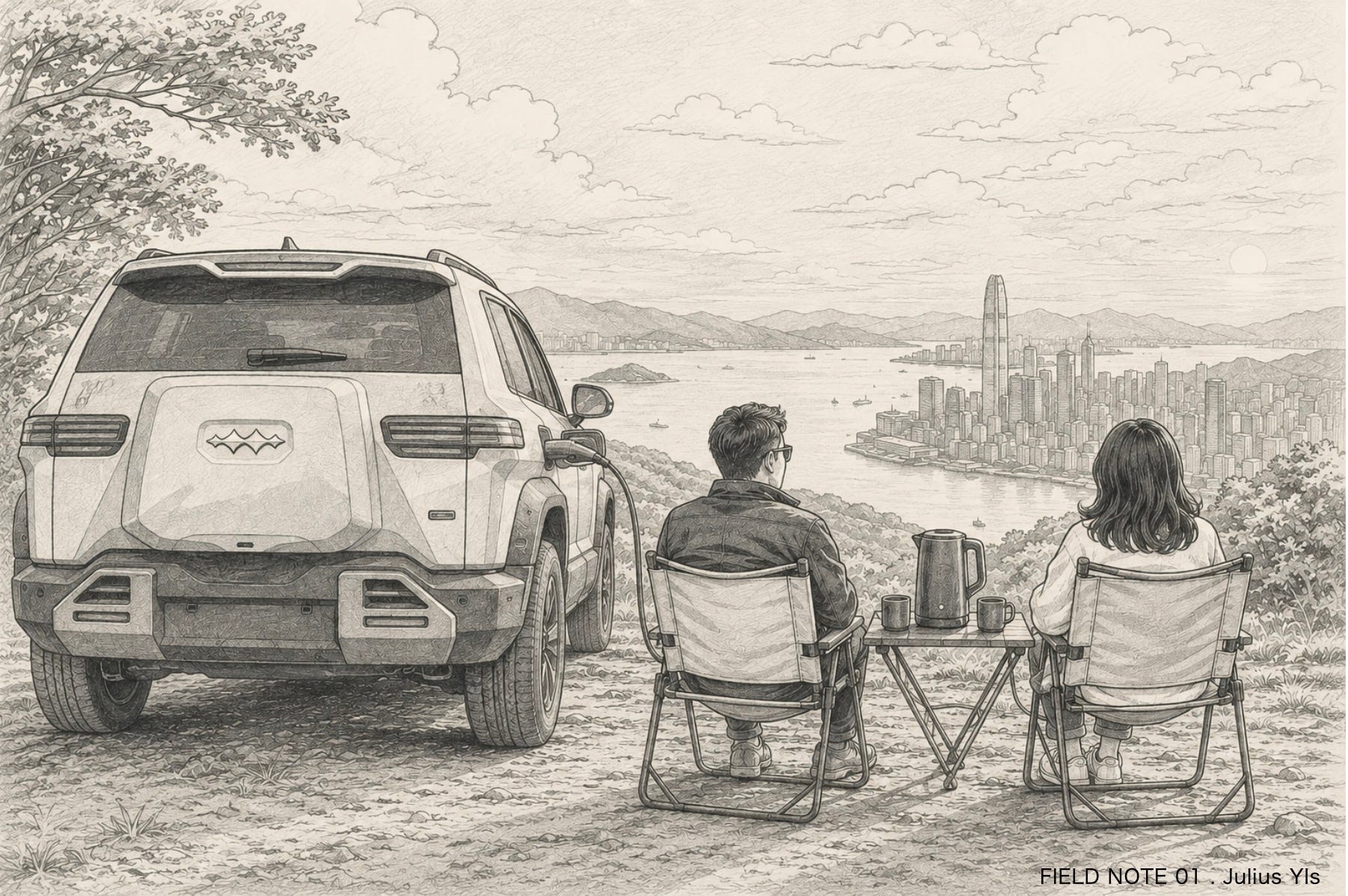
Another small moment happened while my wife and I were light camping in the mountains. We wanted to make tea, so instead of bringing a separate generator or looking for a power outlet, we connected our tea boiler to the car and used the vehicle’s battery as our electricity source.
We boiled the water, made our tea, and sat there surrounded by the mountains. It was a very ordinary moment, but afterwards I realised that something about the relationship had changed again.
For most of my life, a car consumed energy so that it could take me somewhere. Now I had arrived somewhere, parked the car, and the vehicle was supplying energy back into the activity around us. The car was not simply transporting us. It was carrying usable energy with us.
That small experience made the boundary around the automobile feel even less certain. Was it still simply a vehicle? A battery? A connected device? A mobile power source? Perhaps it was becoming all of these things at once.
When a Familiar Object Changes
This is what I find most interesting about living with the car. I initially approached the transition from petrol to electricity as an engineering problem: engine versus motor, fuel tank versus battery, petrol station versus charger. Those comparisons now seem too narrow.
What has changed most for me is not the propulsion system. It is my relationship with the object itself. The car used to be something I operated mechanically. Now it is something I also interact with digitally. It communicates, updates, connects with other systems, stores energy, and can make that energy available somewhere else.
Because the infrastructure around it is increasingly integrated into places I already visit, my behaviour has begun changing with it.
None of this happened dramatically. There was no single moment when somebody announced that the meaning of the automobile had changed. Instead, there were many small moments: checking the car from my phone, talking to it while driving, plugging it in while having lunch, using its battery to boil water in the mountains, and realising that I had stopped thinking about charging as a separate activity.
Individually, none of these moments seemed particularly important. Together, they began changing what the word “car” meant to me.
After thirty-five years of driving, I had assumed I understood this object very well. I am no longer quite so certain. Perhaps that is what makes technological change difficult to recognise while we are living through it. The technology does not always arrive with a dramatic announcement. Infrastructure appears gradually, new behaviours form around it, and things that initially feel unusual become convenient, then familiar, and eventually ordinary.
Only afterwards do we realise that the object we thought we understood has become something else. For me, the EV was simply where I first noticed it. The more interesting question is how many other familiar things around us may be changing in the same way.