

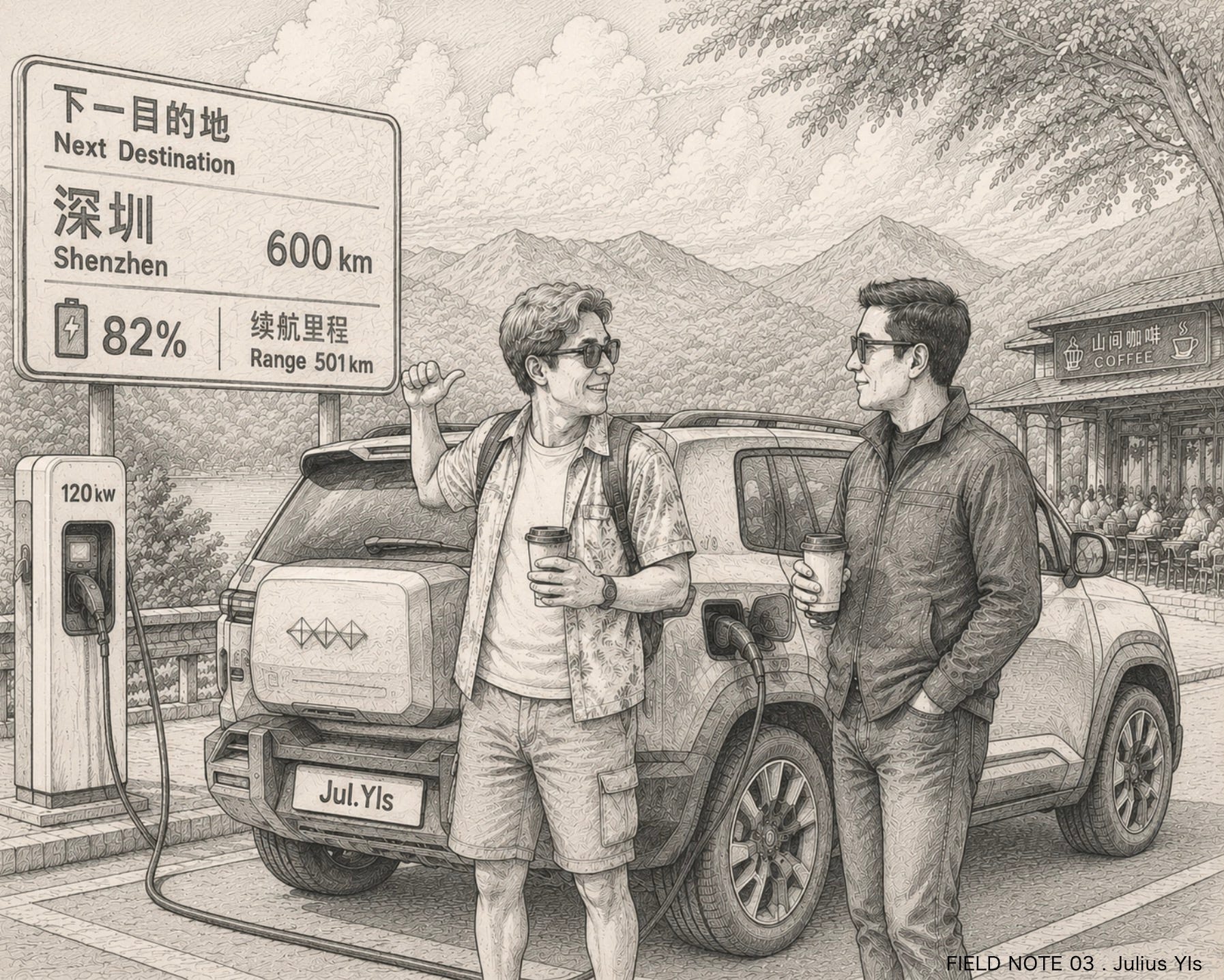
It was a Sunday morning when I met a colleague who had recently arrived in China from Europe. We found a quiet café and spent the morning catching up over coffee. At some point, the conversation drifted towards my new electric vehicle.
He was curious about the technology, the software, and how much of the driving experience now seemed to revolve around a screen. Then I mentioned that I had recently driven from Xiamen to Shenzhen, a journey of around 600 kilometres.
His expression changed. “Really? I thought this car only had around 500 kilometres of range?”
It was a perfectly reasonable question. My car’s official range is around 500 kilometres, so he was doing something most drivers would naturally do: comparing the distance of the journey with the amount of energy the car could carry.
What caught my attention was that only a few months earlier, I would probably have asked exactly the same thing.
The Way We Learned to Refuel
For more than thirty-five years, petrol cars taught me a familiar rhythm. I watched the fuel gauge fall, waited until the tank was getting low, found a petrol station, stopped what I was doing, filled the tank, and continued.
Whether I was driving in Australia, New Zealand, Southeast Asia, the Middle East, or China, the basic relationship was much the same.
Refuelling was an activity of its own. The petrol station was somewhere I deliberately went because the car needed energy.
When I first bought an EV in China, I brought that rhythm with me. I kept watching the remaining range and thinking ahead about where I would charge next. Even though the vehicle had changed, I was still imagining energy in the same sequence: drive, run low, find somewhere to refill, continue.
Living with the car gradually began changing that.
When Charging Became Part of Something Else
I started noticing that many of the places I was already going also happened to have chargers. Shopping centres, public car parks, restaurants, hotels, office areas, tourist destinations, and highway service areas increasingly allowed charging to happen alongside another activity. That changed the experience more than I expected.
Instead of asking, “Where should I go to charge?”, I increasingly found myself somewhere for another reason and realised that I might as well plug the car in while I was there.
Charging began attaching itself to other activities: Lunch, Coffee, Shopping, A hotel stay, A break during a long drive…
The energy still had to come from somewhere, of course. Nothing had physically disappeared. What changed was the amount of attention I gave the process.
Charging was slowly becoming something that happened in the background.
The Smartphone Beside My Coffee
Sitting in the café with my colleague, I looked at the phone beside my coffee cup and realised that I already had another relationship with energy that worked this way.
I rarely make a special journey to charge my phone.
I plug it in before going to bed. I connect it while working. I leave it on a charger while doing something else. Most of the time, charging the phone is not the activity. It simply happens alongside whatever I am already doing.
The important change is not that the battery has become irrelevant. I still notice when my phone is nearly empty. But I rarely organise my day around the act of charging it.
Living with an EV in China made me wonder whether my relationship with vehicle charging was beginning to move in a similar direction. Not because range had stopped mattering, but because energy was increasingly available within places and routines that already existed.
What I Remembered Was the Coffee
The drive from Xiamen to Shenzhen had not been planned as an experiment. I was not trying to prove anything about electric vehicles. It was simply somewhere I needed to go. During the journey, I stopped when I wanted a break. I had coffee, stretched my legs, used the facilities, and continued driving. During those pauses, the car gained enough energy for the next part of the journey.
Looking back afterwards, something surprised me. I could remember the journey. I could remember where I stopped. I could remember the coffee. I could barely remember the charging.
That was the moment when the conversation with my colleague began to make sense. He had been thinking about the journey in terms of 600 kilometres versus 500 kilometres of battery range. I had experienced it as a sequence of driving and ordinary pauses. The charging had happened inside those pauses. The difference was small, but it changed the way the journey felt.
When Infrastructure Becomes Invisible
This made me think differently about infrastructure. We often notice infrastructure most clearly when it is missing. We notice a weak mobile signal, a road closure, an unavailable payment system, or a power cut because something we expected to work suddenly stops working.
When infrastructure works well, the opposite can happen. It fades into the background.
I do not think about the network every time my phone receives a message. I do not think about the banking system every time I tap to pay for coffee. Most of the systems supporting those actions have become almost invisible because they are already woven into ordinary life.
Something similar was beginning to happen with charging. The charger itself had not disappeared. The energy had not disappeared. The infrastructure had actually become more extensive. What was disappearing was my need to treat charging as a separate event.
That distinction now seems more interesting to me than simply asking how quickly a battery can charge or how far a particular vehicle can travel. Those numbers matter, but they describe only one part of the experience. A 500-kilometre battery means something very different depending on what exists around it.
Perhaps this is one way technological change becomes ordinary. Not when we stop using the technology, but when we stop organising our attention around it. Months earlier, I had worried about where I would charge an electric car. Now, after a 600-kilometre journey, what stayed in my memory was the coffee.
Cool. Did not know you have stack, subbed