

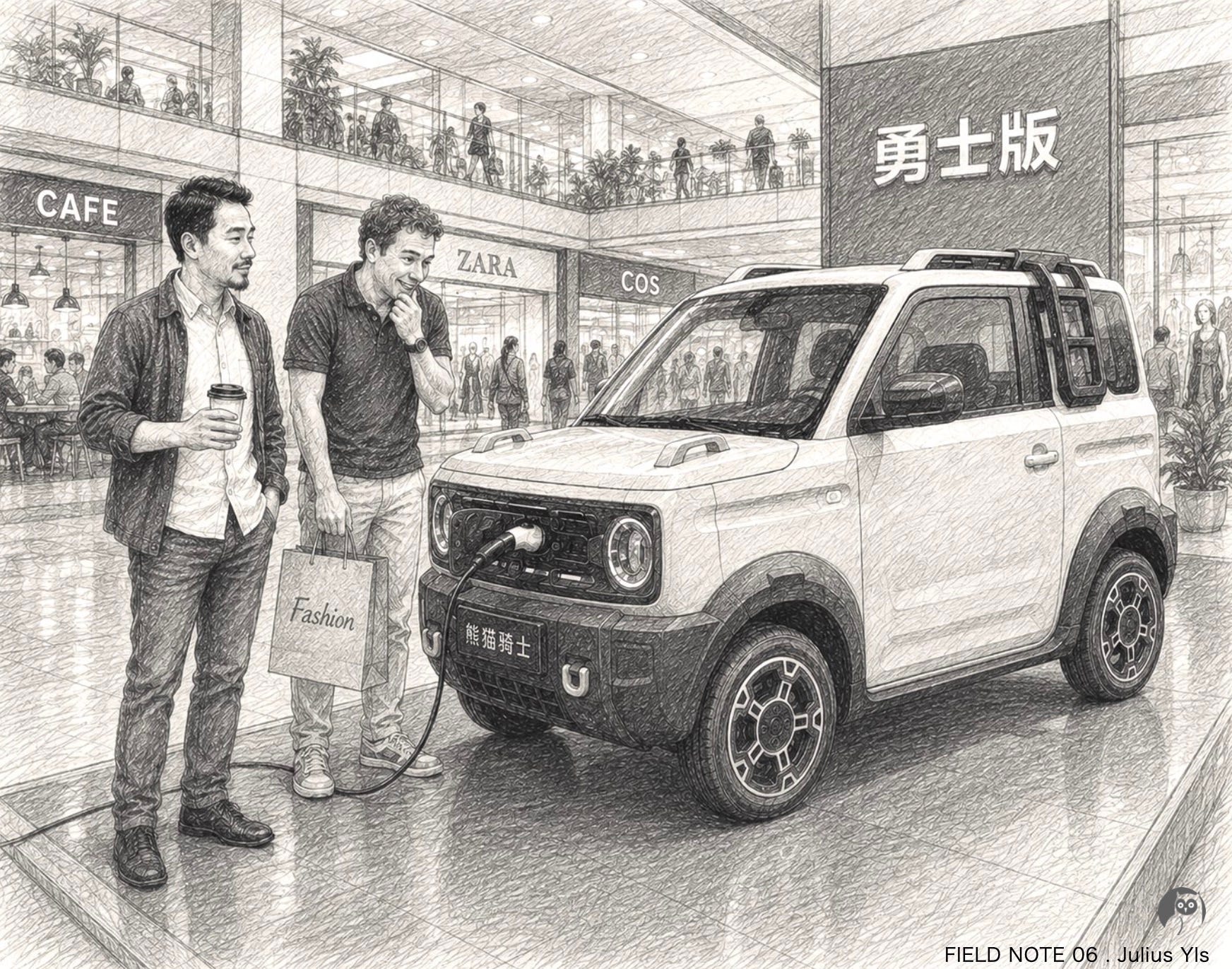
A few weeks ago, an old colleague from Europe was visiting China, and we were walking through a shopping mall when he began noticing the cars. Not in the car park, but Inside the mall. Between clothing stores, cafés and restaurants were several electric vehicle showrooms. This has become so normal to me that I barely pay attention to it anymore. But for someone visiting, it was difficult to miss.
We wandered into one of them. There were large SUVs, family cars and expensive models with enormous screens and more technology than either of us probably needed. Then we stopped beside one of the smallest cars in the showroom. It was a simple city EV. Nothing particularly luxurious. Enough range for everyday driving, a surprisingly decent interior, and many of the things you would expect from a modern car.
Then we looked at the price, which converted roughly into US dollars, it was around $8,000. My colleague stared at it for a moment, then he sighed:
“Gosh. I wish we had something like this back home.”
The Price Was Only Part of It
His reaction stayed with me because affordable electric cars are still relatively unusual in much of Europe. That is beginning to change. More lower-priced models are appearing, and the gap between electric and petrol cars has been narrowing. But the difference is still significant.
According to the International Energy Agency, fewer than 10 percent of battery electric models available in Europe in 2025 were priced below €30,000. About a quarter of combustion models were below that level. Across the market, battery electric cars still carried an average price premium of around 20 percent.
So his sigh made sense. But standing in that shopping mall, I began wondering whether we were looking at the wrong perspective. Perhaps the interesting thing was not that this particular EV cost around $8,000. Perhaps it was everything around it.
When the Car Is Part of a Larger System
Since buying an EV in China, I have spent a lot of time thinking about charging. At first, I approached it much like I once approached petrol. Where is the charger? How long will it take? What happens if I cannot find one?
After driving thousands of kilometres, including long highway trips, those questions gradually became less important. Charging started appearing wherever the rest of my life was already happening such as Shopping malls, Restaurants, Hotels, Highway service areas, Office buildings, Public car parks, etc. Sometimes I charge because I need electricity. Quite often I charge simply because the car is parked somewhere that happens to have chargers.
The same thing is happening with the cars themselves. There are tiny city EVs, taxis, family sedans, delivery vehicles, SUVs, sports cars and luxury cars. Electric buses have been part of city streets for years.
Car showrooms appear inside shopping malls because that is where people already spend their time. The EV is not sitting outside everyday life waiting for people to adopt it. It has moved inside.
Cheap Cars Need More Than Cheap Batteries
Of course, charging infrastructure does not directly explain why one car costs $8,000 and another costs €30,000. Car prices come from many things: manufacturing scale, battery costs, supply chains, competition, regulation, tariffs and decisions by manufacturers about which kinds of cars they believe their customers will buy.
China has spent years developing a very large domestic EV industry, and competition between manufacturers is intense. The result can now be seen in the numbers. In 2025, nearly 70 percent of battery electric cars sold in China were already cheaper than comparable combustion cars, even before government incentives were considered.
But I think infrastructure still changes something important. It changes the risk surrounding the purchase.
An inexpensive electric car is much less useful if the buyer is constantly wondering where it can be charged, who can repair it, whether there will be chargers on a long journey, or whether the technology will still be supported a few years from now.
Once the ecosystem becomes common enough, those questions begin to disappear. And when they disappear, manufacturers can sell electric cars to people who are not particularly interested in electric cars. They are simply looking for a car.
When Technology Stops Announcing Itself
This may be one of the biggest differences I have noticed while living with an EV here. In many conversations elsewhere, an electric car is still discussed as a category.
Should I buy an EV?
Is an EV practical?
Can I live with an EV?
Those are reasonable questions. I asked many of them myself. But when a technology becomes deeply embedded in everyday life, the question slowly changes. People begin comparing size, price, comfort, design and features instead. The electric part becomes less interesting.
Standing beside that little car in the shopping mall, my colleague was looking at something that was still unusual enough to surprise him. I was looking at something I had almost stopped noticing. Perhaps that difference matters more than the $8,000 price tag.
From My Notebook
Affordable technology is not only created by making the product cheaper. It also becomes affordable when the world around it is ready for it.
The chargers, repair networks, supply chains, parking spaces, software, manufacturers and even the expectations of ordinary drivers all become part of the price we do not see on the sticker. The small EV in the shopping mall was inexpensive. But what made it feel truly cheap was that almost nothing around it treated it as unusual anymore.
“inexpensive” is the sticker price; “affordable” is the whole environment that makes ownership practical.
The problem with an $8,000 car is that people will immediately become suspicious. As much as we all want the affordability, we are also inherently mistrusting when prices don’t match our expectations. People will assume that car won’t last 3 years.