

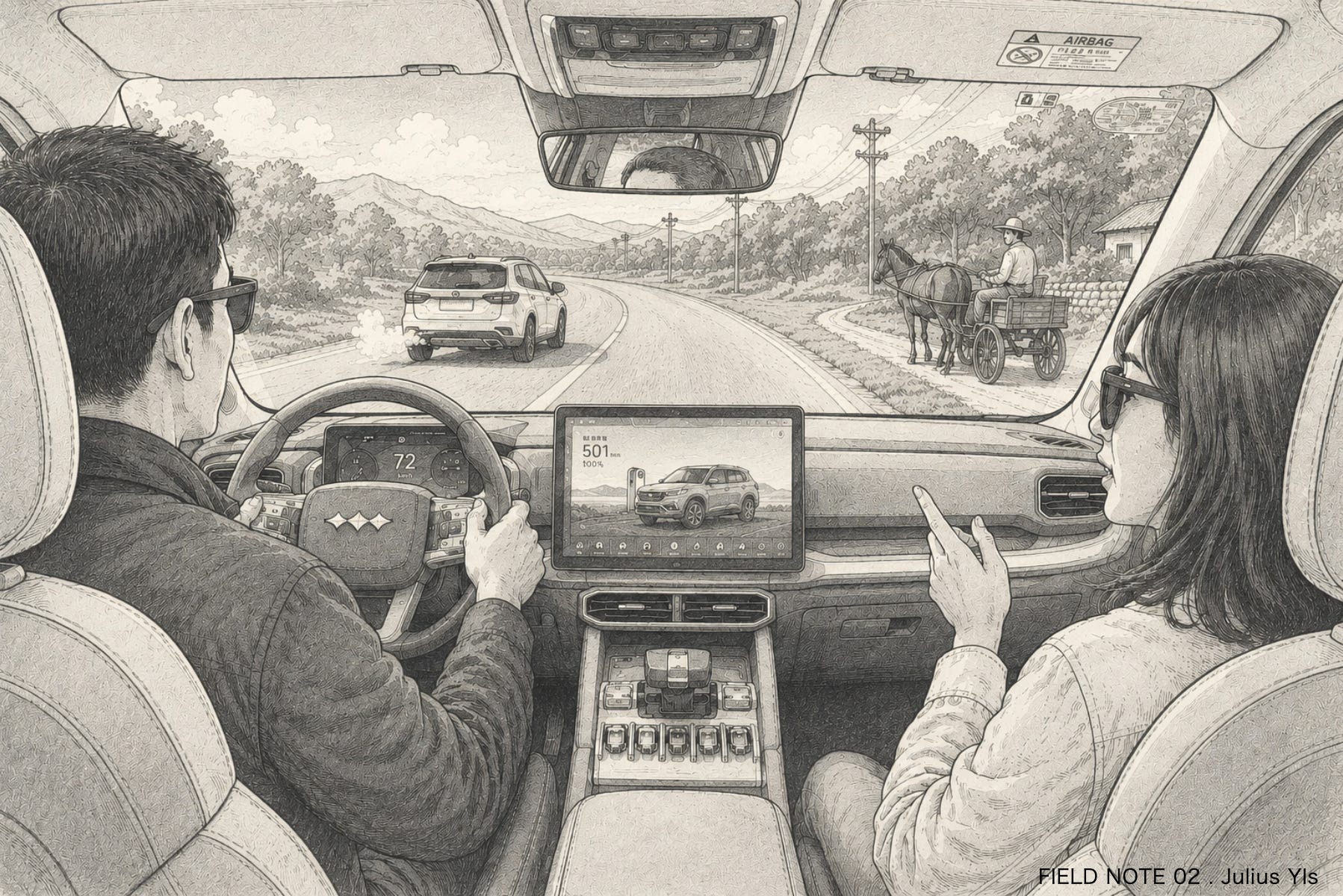
One evening in our apartment garage, I watched a neighbour arrive home in their EV, step out of the car, and start walking towards the elevator. The car then moved itself into the parking space while its owner was already leaving. The whole thing took only a few moments.
Meanwhile, I was still sitting behind the wheel of my own EV, carefully adjusting my position, checking the mirrors, and making small corrections as I had done for decades. My wife looked at me and smiled. “You know you’re driving this EV like an ICE car?” She said it casually, almost as a joke. But she was completely right.
Our car came with intelligent parking features that I had seen demonstrated when we bought it. It could recognise the space around it, calculate the available room, and park itself with very little input from me. I had turned most of those features off. Not because I disliked the technology. I was not particularly worried that it would fail. I had simply continued doing what I already knew how to do.
The problem was not the car. It was habit.
What I Thought Driving Meant
After more than thirty-five years of driving petrol cars in different parts of the world, I had developed a strong idea of what controlling a car should feel like. I trusted my own judgement, my experience, and the familiar sequence of steering, checking mirrors, judging distance, and making corrections myself.
Being a good driver meant being in control. Or at least that was what decades of driving had taught me.
The more I thought about my wife’s comment, the more uncomfortable the idea became. I realised that I had not simply learned how to drive. I had learned how to operate a particular generation of automobile.
The sounds of an engine, the response of a gearbox, the movement of a fuel gauge, the routine of filling a petrol tank, and the assumption that the driver should make every operational decision had gradually become my definition of driving itself.
I had confused familiarity with permanence. Now the physical system around me was changing, but the mental model I brought into the driver’s seat had not changed with it.
The Horseless Carriage Problem
There is an old idea associated with Marshall McLuhan that we often understand new technologies through the language and assumptions of the technologies they replace. The early automobile, for example, was initially understood as a horseless carriage.
The description makes sense. When something unfamiliar appears, we naturally begin with what we already know.
Psychology describes a related tendency through what is known as the Einstellung effect. Once we have developed a solution that works, we can become so accustomed to it that we continue applying it even when a different approach becomes possible.
Sitting in the garage, I realised that I was doing something similar. I was not rejecting the EV. I had already bought one. But I was translating the new car back into a mechanical language that I had spoken for most of my adult life. I expected it to behave like the cars I knew, and more importantly, I expected myself to behave in exactly the same way around it.
In a sense, I had bought the new technology while keeping the old driver.
When Experience Becomes Habit
That distinction has stayed with me because I have seen versions of it before. During my years working with interactive media, digital systems, education, and emerging technologies, new tools often arrived with considerable excitement. But one of our first instincts was usually to use them to reproduce something we were already doing.
Early digital environments recreated pages, folders, desktops, classrooms, galleries, and other familiar structures. More recently, generative AI has often been introduced by asking how it can make an existing task faster: write this document more quickly, produce this image more efficiently, search for this information more conveniently.
Those uses can be perfectly sensible. But they also raise another question. What if the more important change is not simply that the new technology performs an old task better? What if it changes the assumptions behind the task itself?
That was what my parking experience exposed. My instinctive question had been: how can these new systems help me park the car? But perhaps the more interesting question was: why did I still assume that parking the car had to be entirely my task The difference is subtle, but it changes the way I look at technology.
Learning and Unlearning
We often describe technological adaptation as a process of learning. Learn the new interface. Learn the new software. Learn where the controls are. Learn what the system can do.
But my experience in the garage suggested that learning may only be half of the process. The other half is recognising what we need to stop doing. That can be much harder.
Experience is valuable because it gives us judgement. It helps us recognise risk, compare situations, and avoid repeating mistakes. But experience also produces habits, and habits can survive long after the conditions that created them have changed.
Perhaps this is why people with considerable experience can sometimes find technological transitions unexpectedly uncomfortable. The difficulty is not necessarily a lack of knowledge. Sometimes we have too much knowledge of the previous system.
I had thirty-five years of evidence telling me what a competent driver should do. The car sitting underneath me was asking whether all of that evidence still applied.
Meeting the New on Its Own Terms
I still park the car myself quite often. Partly because I enjoy driving, and partly because there are situations where I simply prefer to make the decision myself. This is not an argument for handing every task over to automation.
What changed was that I became more conscious of why I was making the choice. Was I choosing to park manually because it genuinely made sense in that situation? Or was I doing it simply because that was what a car had always required me to do?
That distinction now interests me far beyond driving.
Whenever I encounter a new technology, I find myself asking not only what I need to learn, but what assumptions I may have carried into the encounter without noticing.
Sometimes the obstacle to understanding something new is not ignorance. It is familiarity. And perhaps one of the most difficult parts of living through technological change is recognising when experience remains useful, and when experience has quietly turned into habit.