

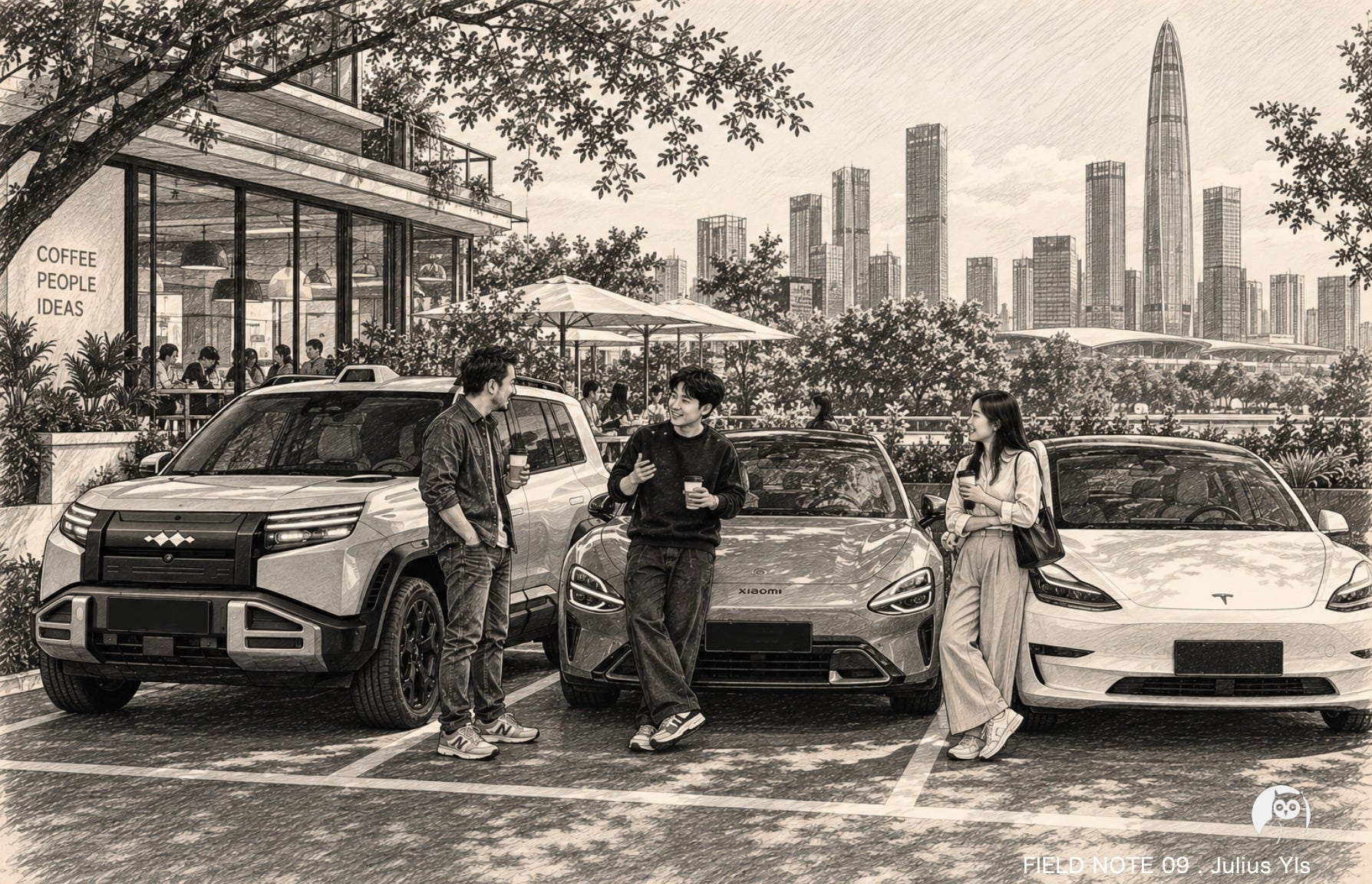
Recently I have developed a small habit with my EV. I keep switching it into Sport mode.
This is surprising because when I bought the car earlier this year, I almost never used it. During the first few months I did almost the opposite. I turned off many of the automatic and intelligent functions, selected Eco mode, and tried to make the car behave in a way that felt familiar. After more than 35 years of driving petrol cars, that felt like a reasonable place to start. The acceleration was gentler, the response more progressive, and the car behaved closer to what my right foot had learned to expect from an internal-combustion engine.
Sport mode felt unnecessary. Now I find myself selecting it almost every time I drive.
The change is not dramatic in the way I would once have understood performance. There is no engine suddenly becoming louder, no rev counter climbing, no gearbox holding onto a lower gear and no exhaust note telling me that something different is happening underneath. The accelerator simply becomes more responsive and the car feels much more immediate. I already knew electric cars could do this. What has started to interest me is how normal it feels.
For much of my life, performance meant something quite different. In the mid-1990s I drove a Nissan 300ZX. In 2008 I drove a Nissan GT-R. Later came cars such as the Ford Raptor and Range Rover, all of which represented different stages in the way electronics became involved in controlling a car.
Drive modes themselves are not new. My 2008 GT-R already had selectable settings that could alter the transmission, electronically controlled shock absorbers and Vehicle Dynamic Control. Nissan described Normal, Comfort and R settings, with R intended for high-performance driving. The 2017 Raptor went considerably further, with six terrain modes that could recalibrate the engine, transmission, four-wheel-drive system, braking and stability controls.
But there was an important difference. Those switches were sitting on top of a great deal of specialised machinery.
The GT-R I drove had a 3.8-litre twin-turbo V6, a dual-clutch transmission, four-wheel drive and electronically controlled Bilstein suspension. The electronics could alter how all of those systems behaved, but the performance itself came from hardware that had been engineered specifically to produce it. If you wanted more performance in those days, you generally bought more machinery: a larger engine, more cylinders, turbochargers, a more sophisticated transmission, stronger brakes, better suspension and a more capable drivetrain.
There was a hierarchy to it, and anyone interested in cars knew the language. Engine capacity mattered. Four cylinders meant something different from six or eight. Naturally aspirated and turbocharged engines had different characteristics. Horsepower and torque figures mattered, as did gearbox type and the number of driven wheels. A normal family car occupied one part of that hierarchy. A sports car occupied another. A GT-R was unmistakably somewhere else.
The numbers from that period help put this into perspective. In 2008, Car and Driver Magazine measured the Nissan GT-R at 3.3 seconds from 0 to 60 mph. It placed the car among the ten quickest vehicles the magazine tested that year, alongside the Porsche 911 Turbo, Ferrari 599 GTB and Bugatti Veyron.
Today many four-door, five-seat electric sedan, with an official 0–100 km/h time of 3.8 seconds. The measurements are not directly comparable and 60 mph is slightly below 100 km/h, and independent testing is different from a manufacturer’s figure. But that is not really the point. The interesting part is the context. A level of acceleration that once belonged to a very small group of exceptional performance cars can now appear in the form of a practical electric sedan.
Electric motors make part of this possible simply because they work differently. The U.S. Department of Energy notes that EVs can produce maximum torque from a full stop, giving them smooth and immediate acceleration. There is no need to wait for an engine to reach the right rev range or for a gearbox to select the right gear.
That does not mean every EV has become a sports car. Far from it. A serious performance car still needs the chassis, tyres, brakes, suspension, thermal management and control systems to match its power. Being extremely quick in a straight line for a few seconds is not the same as being able to perform consistently on a demanding road or track.
But one of the most visible signals of performance that are strong and immediate acceleration has become much easier to provide.
My own car demonstrates this in a much less extreme way. I did not buy it because I wanted a performance vehicle. It is a rear-wheel-drive EV that I chose for completely different reasons. Yet somewhere among its normal settings is Sport mode, and pressing it changes the character of the car enough that I now enjoy using it.
Twenty years ago I would probably have regarded that sort of response as one of the qualities that separated a performance car from an ordinary one.
Today it is simply one of the settings.
Speed no longer Being the Difference
This is where I think the meaning of performance becomes more interesting.
I would not say that performance no longer matters to EV buyers. The evidence actually suggests otherwise. McKinsey’s 2025 global mobility survey found that Chinese EV buyers placed more importance on driving performance than consumers in Europe and the United States. But the same research found that range and charging speed were among the leading EV purchase criteria across markets. In China, driver assistance and new technology also ranked particularly highly.
So perhaps performance has not become irrelevant. It has become less able to distinguish one car from another on its own.
That seems closer to what I hear in conversations with younger people around me in China. When we discuss cars they might buy, the conversation is often about range, charging, software, intelligent-driving functions, screens, interior space, design and price. They may still appreciate a fast car, but engine performance does not occupy the position it did in so many of the car conversations I grew up with.
There is a particular reason China makes this interesting to observe.
China has a car culture, and a very active one, but the period of mass private-car ownership is much shorter than in many countries where cars had already been embedded into family life for generations. China’s National Bureau of Statistics recorded about 3.65 million privately owned passenger cars in 2000. By 2020, privately owned cars numbered about 146.7 million. In only two decades, private car ownership had expanded on an extraordinary scale.
Then the technology changed again.
According to the International Energy Agency, more than 13 million electric cars were sold in China in 2025, representing close to 55 percent of all new-car sales. By the end of that year, nearly 700 electric car models were available in the Chinese market which about 60 percent more than the number of conventional models.
This creates a very different timeline from the one I experienced.
I grew up with internal-combustion cars already established as part of everyday life. There was enough time for an entire culture to form around the machinery: engine sizes, cylinders, exhaust sounds, gear changes, modifications, performance versions and the gradual progression from an ordinary car to something faster and more desirable. Those distinctions became part of how many of us understood cars.
For a young driver buying a first car in China today, that mechanical hierarchy may have had much less time to become fixed. Their first car might already have instant torque, selectable driving modes, large displays, software updates and sophisticated driver assistance. They do not necessarily have to progress through years of increasingly powerful engines to experience strong acceleration. It can be there from the beginning.
That may eventually affect what manufacturers have to do to make a car desirable.
McKinsey’s 2026 China consumer research already gives a clue. It found that range and charging time had become the leading purchase factor for EV buyers, while advanced driver-assistance and AI functions were moving toward baseline expectations. Sixty-nine percent of respondents regarded advanced functions such as city Navigate-on-Autopilot as essential.
None of this means that the pleasure of driving is disappearing. Nor does it mean performance cars will disappear. I suspect the opposite: if straight-line acceleration becomes commonplace, genuine performance cars may have to prove themselves in more sophisticated ways.
How consistently can the car deliver its power? How does it manage heat? How well does it brake after repeated hard use? What happens when the road begins to curve? How much information comes back through the steering and chassis? Can the driver feel something beyond the initial push into the seat?
Perhaps this is where performance begins to separate from acceleration again.
I find that idea interesting because I have lived through several versions of the same transition. In the 300ZX, performance was something I associated strongly with the machinery. In the GT-R, electronics were beginning to coordinate an extraordinary collection of mechanical systems. In the Raptor and Range Rover, selectable modes became increasingly sophisticated ways of adapting those systems to different conditions.
Now I get into an EV that I did not buy as a performance car, select Sport, and enjoy the response without giving much thought to what is happening underneath.
The machinery has not disappeared, of course. It has simply become less visible to me as a driver.
For decades, performance helped tell me what kind of car I was driving. It separated the normal car from the sports car, and the sports car from something exceptional.
I am beginning to think EVs are changing that distinction.
Performance still matters.
It just may no longer be enough to make a car special.